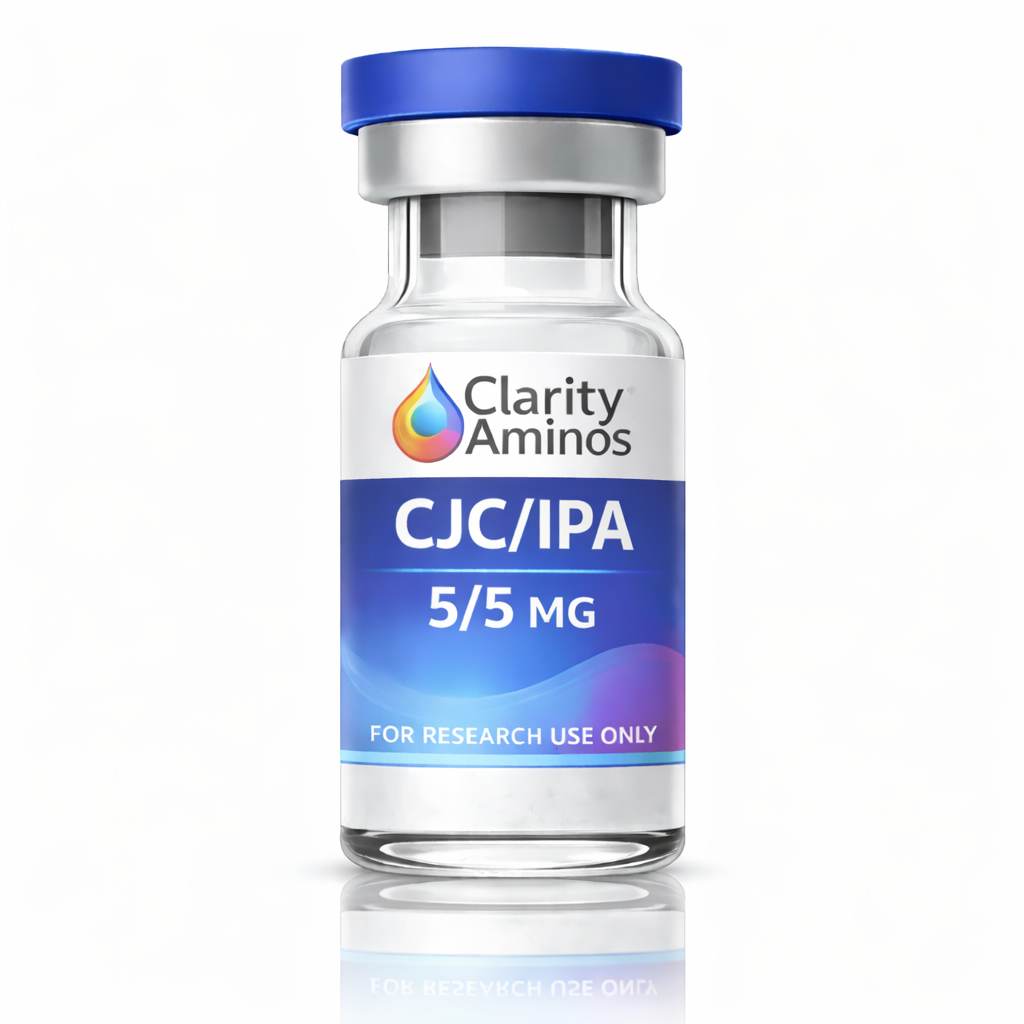
CJC-1295 5MG / IPAMORELIN 5MG
$65.00
High-purity (≥98%) CJC-1295 without DAC, third-party lab tested for research on short-acting growth hormone–releasing hormone analog pathways. For research use only.
Availability: 10 in stock
CJC-1295 & Ipamorelin (5 mg / 5 mg) — Research Peptide Blend
Overview
CJC-1295 and Ipamorelin are two complementary synthetic peptides widely used in laboratory and preclinical research to explore growth hormone (GH) axis regulation and somatotropic signaling. This blend pairs a growth hormone–releasing hormone (GHRH) analogue (CJC-1295 no DAC) with a growth hormone secretagogue (Ipamorelin) in a dual-mechanism formulation designed to engage distinct receptor pathways upstream of GH release.
Mechanism of Action
CJC-1295 (no DAC) is a stabilized analog of the endogenous GHRH signal that binds to the anterior pituitary’s GHRH receptors, leading to activation of adenylate cyclase and cyclic AMP–mediated pathways that support somatotropic signaling.
Ipamorelin is a selective ghrelin receptor (GHS-R1a) agonist that stimulates GH release via calcium-linked signaling while exhibiting minimal activity on other pituitary hormones.
The combination harnesses two different biochemical inputs — one at the GHRH receptor and one at the ghrelin receptor — enabling researchers to investigate dual-pathway modulation of GH pulsatility, peak release patterns, and receptor dynamics in controlled experimental systems.
Typical Research Applications
This blend is suited for experimental designs focused on:
Studying pulsatile and sustained GH release models in vitro or in vivo
Examining endocrine feedback and receptor cross-talk in somatotropic pathways
Evaluating growth hormone axis dynamics, including GH/IGF-1 responses and associated signaling mechanisms
Investigating peptide synergy and modulation of hypothalamic–pituitary communication channels
Product Features
Dual peptide blend: CJC-1295 (no DAC) + Ipamorelin
Supplied as lyophilized peptide powder
Designed for research use in laboratory and preclinical settings
Provided with documentation for identity and purity verification (COA available)
Important Notice
This product is intended for laboratory research use only. It is not approved for human consumption, therapeutic application, veterinary use, or medical diagnosis. Researchers should follow all applicable safety protocols and regulatory guidelines when handling or studying peptide materials.
Related products
-
Peptides
CLA-2P 30MG
$125.00 Add to cartA synthetic research peptide studied for its role in metabolic signaling, hormone communication, and nutrient metabolism pathways. Supplied as a 20mg lyophilized peptide for laboratory research purposes only.
-
Peptides
GHK-CU 100MG
$55.00 Add to cartGHK-Cu (Copper Tripeptide-1) is a copper-binding peptide studied in laboratory research for its role in cellular signaling, tissue remodeling pathways, and regenerative processes. Supplied as a 100mg lyophilized peptide for research use only.
-
Peptides
CLA-2P
Price range: $85.00 through $139.00 Select options This product has multiple variants. The options may be chosen on the product pageA synthetic research peptide studied for its role in metabolic signaling, hormone communication, and nutrient metabolism pathways. Supplied as a 20mg lyophilized peptide for laboratory research purposes only.
-
Peptides
Sermorelin 10mg
$65.00 Add to cartSermorelin is a GHRH analog peptide used in research to study natural growth hormone signaling and metabolic pathways. Supplied as a 10mg lyophilized peptide for laboratory research purposes.